

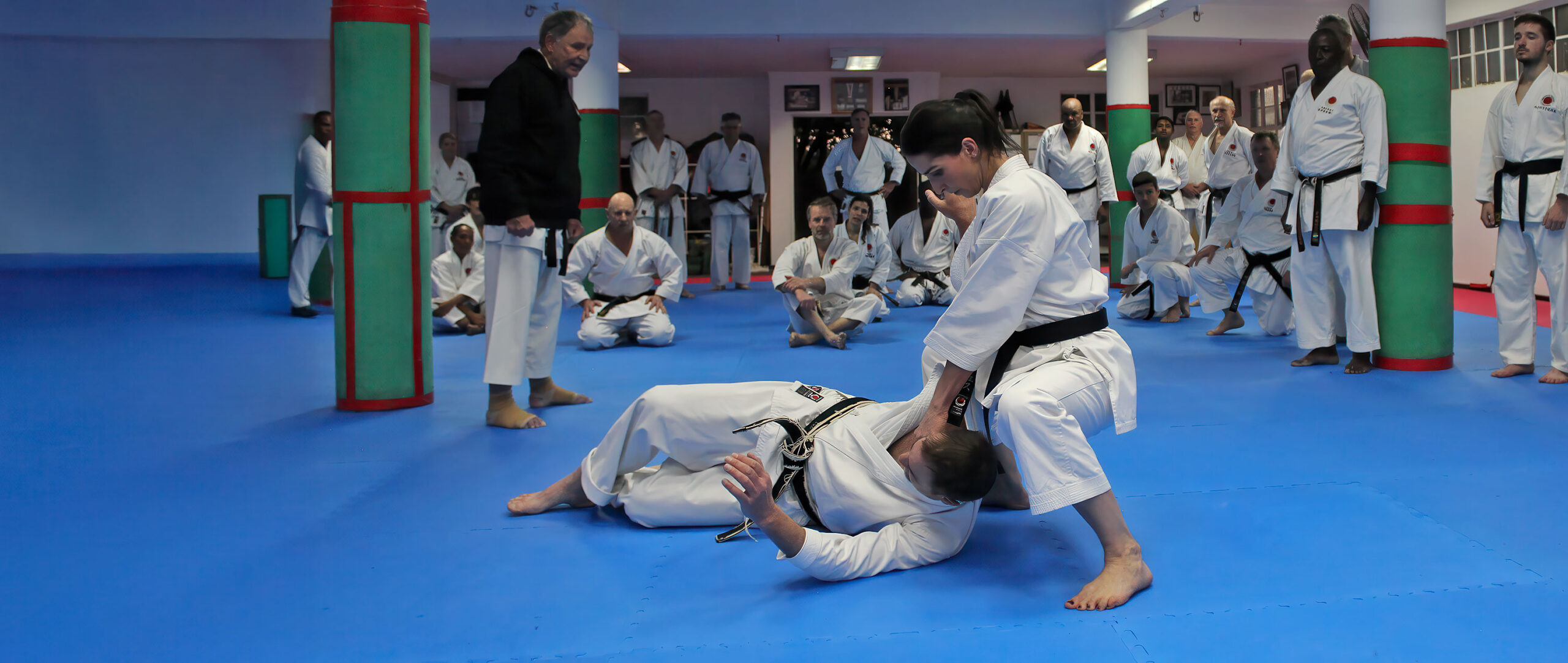
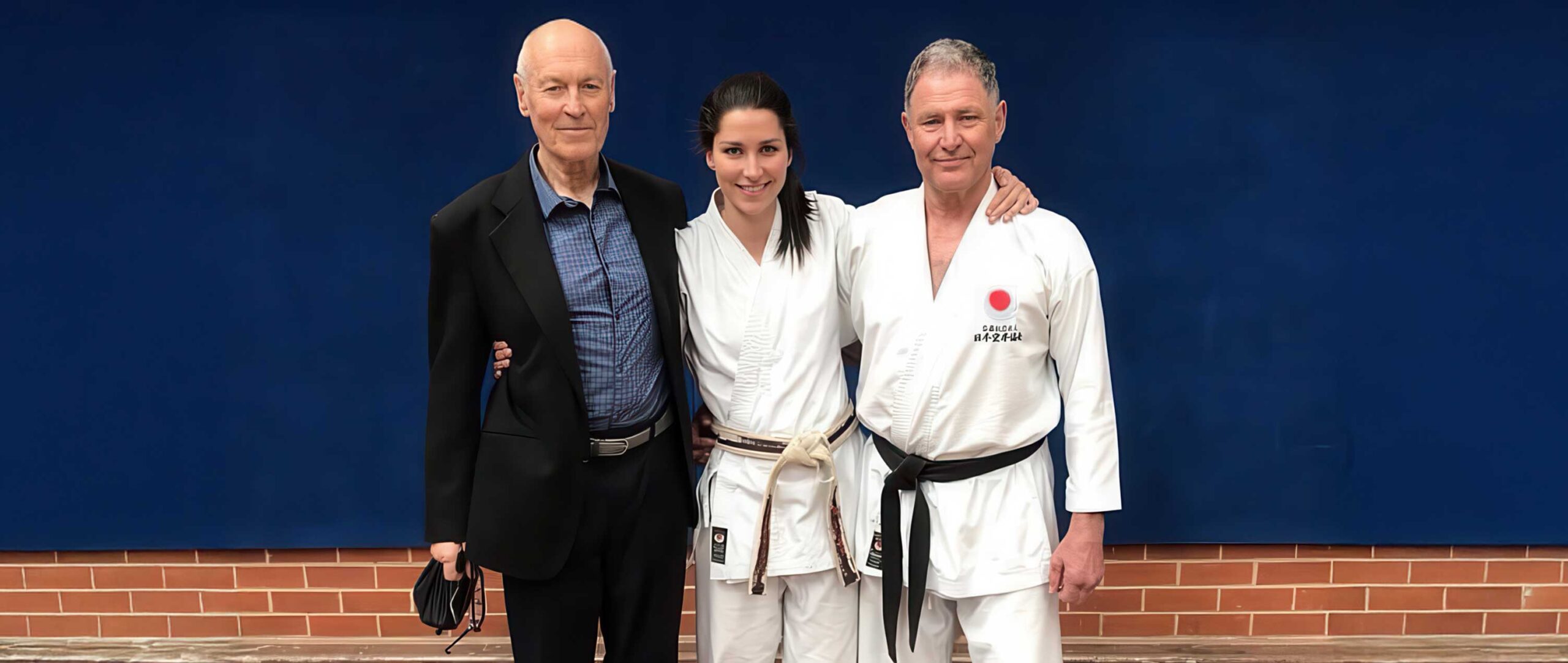
Sensei Jess Geyer and her father, Sensei Keith Geyer, from JKA SKC Australasia, recently visited South Africa to teach a seminar at the SA JKA Honbu dojo. I had the privilege of helping with photography, which gave me a front-row seat to this powerhouse duo in action—and wow, what an experience. The depth of history, the precision, the timing… it was something special. Sensei Jess has kindly allowed us a glimpse behind the scenes in this interview. Thank you, Sensei. Oss!
LEGACY AND LINEAGE
Sensei Richard Amos once described your kihon as “super crisp technique and perfect posture.” That’s high praise from a globally respected figure. What did that mean to you — not just personally, but in the context of your family’s legacy?
Hearing that from Richard Sensei honestly meant a lot. I’m someone who usually just keeps my head down and focuses on the work – I’ve never been one for the spotlight. But when recognition like that does come, it hits differently. It’s a quiet affirmation that all the years, effort, and intention haven’t gone unnoticed. More than anything, it reminded me that the values my dad and grandfather passed down are still very much a part of how I train and carry myself.
With both your father, Sensei Keith Geyer, and your grandfather, Sensei Stan Schmidt, being such strong pillars in JKA history, how did their influence shape the way you see karate?
I’ve always felt extremely lucky and blessed to have grown up learning from them. I knew I was in good hands – my dad and grandfather had such solid foundations, not just technically but in the way they lived and taught karate. Both trained in Japan for months during the ‘Golden Era’ which gave them a depth of knowledge and experience you just can’t replicate. For me growing up, I had this unique window into that world – not just through training, but through their stories and reflections. Hearing how karate was back then, how it’s evolved – that kind of insight isn’t something many people get to inherit. It’s something I have really valued and has always given me a sense of trust in the way I was being guided. It made me feel grounded, like I was part of something meaningful.
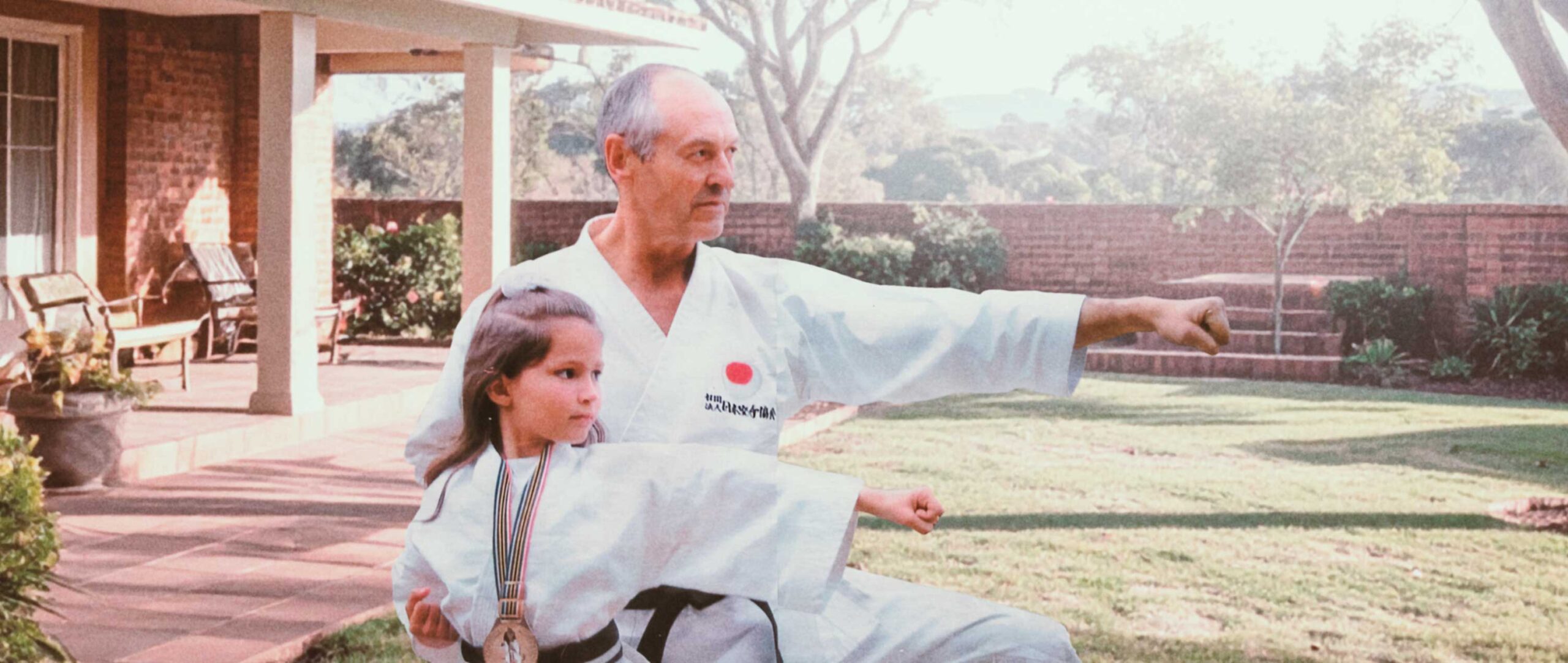
As a baby my dad would carry me on his hip while running kata sessions with his senior students. He always says those moments are what sparked my passion – and he’s probably right! But I officially began training at age four, and not long after that, my training was centred around competition. My dad was the national coach, and I trained as part of a squad that felt more like a family. We travelled all over South Africa and the world together, and competition was what really drove me for a long time.
But things started to shift in my late teens and early adulthood, especially after we moved to Australia. My grandfather in particular inspired me to be curious and open – to explore other martial arts and understand how they could enrich my own training. He believed in building a strong foundation but also evolving beyond it, and that had a big impact on how I started to see karate: not just as a competitive pursuit, but as a lifelong discipline.
The values they both passed down – desire, discipline, dedication, and determination are what really shaped me. And they always reminded me that karate is about more than technique. It’s about character, connection, and continuing something with heart and purpose.
Was there a moment early on when you realised that karate wasn’t just something you did — it was going to be part of who you are?
Honestly, it’s always just felt like a part of who I am. There was never a big decision or turning point – I just did it! But if I think back, moving to Australia was probably where things really shifted. Watching my dad go from running a thriving dojo in South Africa, where he was well recognised and respected, to starting completely from scratch here… that was hard. He gave up everything for me and my siblings, and even as kids, I think we understood how big that sacrifice was. I wanted to support him however I could. I was 12 at the time, and from that point on, I went to every class, helped demonstrate, and did whatever I could to help him rebuild. Looking back, maybe it was during those years that karate really became part of me.
TECHNIQUE AND PHILOSOPHY
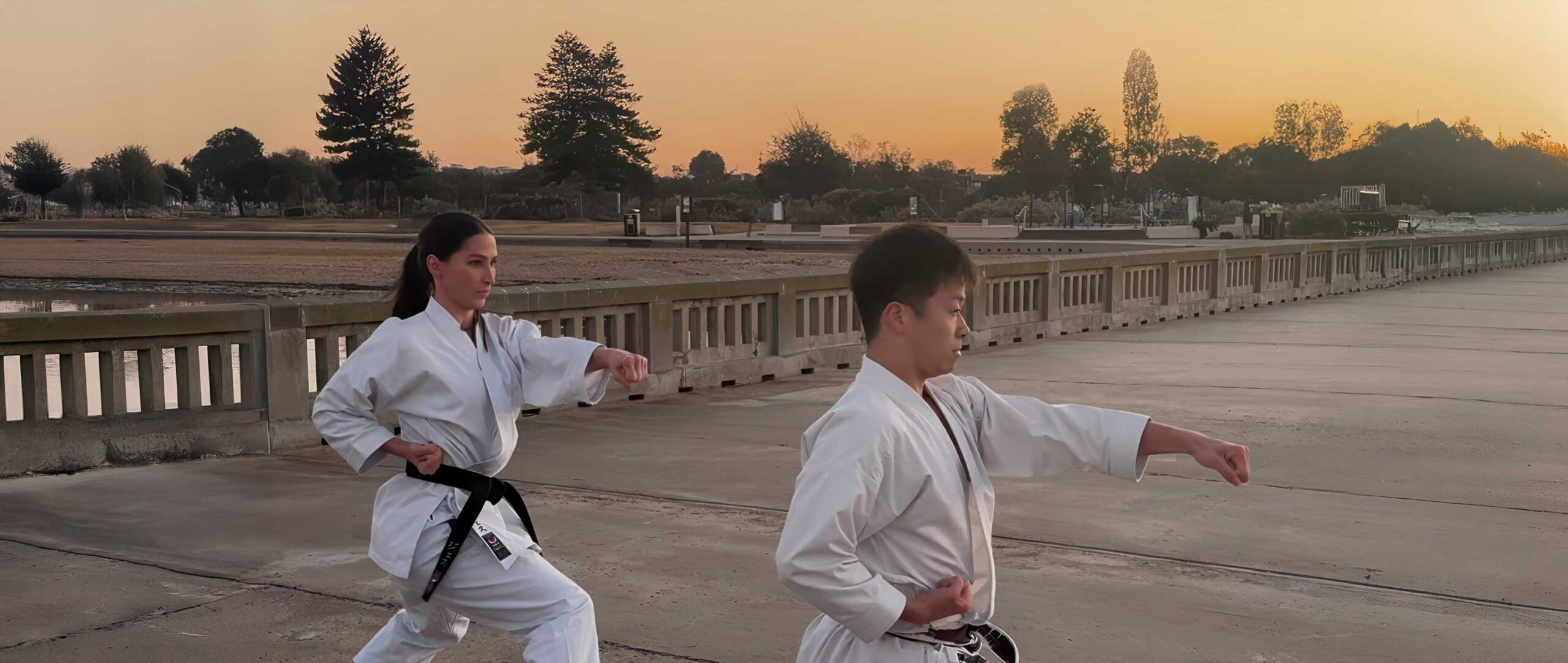
You’ve become known for your precision and clean form. Could you share a bit about your personal training approach — what’s behind that level of refinement?
That really means a lot because that’s exactly what I strive for. Honestly, I believe high-level karate isn’t for the faint-hearted. Like any serious pursuit, it takes more than passion. You need the desire to want it, the discipline and dedication to show up again and again, and the determination to keep going when it gets hard. I’m a perfectionist with a love for the detail but reaching this point has taken countless hours of focused, consistent hard work (and many hours studying the top Japanese kata athletes!).
If there’s one person to credit for my “precision and clean form,” it’s my dad. His quality teaching and instruction has always emphasised building a solid foundation and a lot of brain training with real intent. He’s instilled in me the belief that it’s the small things, done consistently well and with purpose, that truly set you apart.
Aside from a great instructor who motivates you, I believe who you stand next to on the dojo floor matters. I make a conscious choice to train beside those who are just as driven, technically focused, and pushing themselves; because it lifts me too. I think that kind of energy is contagious and it’s one of the fastest ways to grow.
I’m also a big believer in supplementary training. I don’t think you can reach your full potential in karate without working on strength, power, balance, and stability outside the dojo. I might be a little obsessed, but my daily weight training schedule has been a huge part of getting my karate to where it is today.
I have recently begun filming my training and it’s something I wish I started a long time ago! A friend convinced me to film my kata and honestly watching it back gives me a whole new perspective (and the occasional cringe!), but it’s been such a useful way to pick apart my technique and make adjustments and refine.
Karate is personal and we get to take ownership of that journey… so I really believe the growth comes from what you put in beyond just showing up to class!
You hold a JKA rokudan (6th degree black belt), which says a lot about your commitment over the years. Has your outlook — physically or philosophically — changed as you’ve moved through the dan ranks?
Definitely – over the years I feel I’ve matured in my approach and mindset. But especially since my Godan grading, I’ve become less about how things look, and more about how they feel – internally and technically. I’m much more focused now on really understanding the mechanics and meaning behind every movement rather than just making it look flashy.
Earning my Rokudan has probably been the most personally rewarding milestone in my karate journey. While I’ve had the privilege of growing up in a strong karate family, that’s come with its own set of challenges. I’ve always felt the need to prove myself – to show that I’ve earned my place, especially at the age I’ve held this grade. I was 34 when I passed my Rokudan, and I remember the immediate worry: that people might say I was too young, that I didn’t deserve it.
It took some real reflection to acknowledge, that while I may be young for the grade, I’ve dedicated my entire life to this art. I’ve trained relentlessly, learned from two of the best instructors in the world – and when Vice Chief Instructor Ogura Shihan awarded me that rank, it wasn’t because of my last name. It was because I had earned it.
Is there a kata (form) that speaks to you more now than it did when you were younger? What’s changed in how you see or approach it?
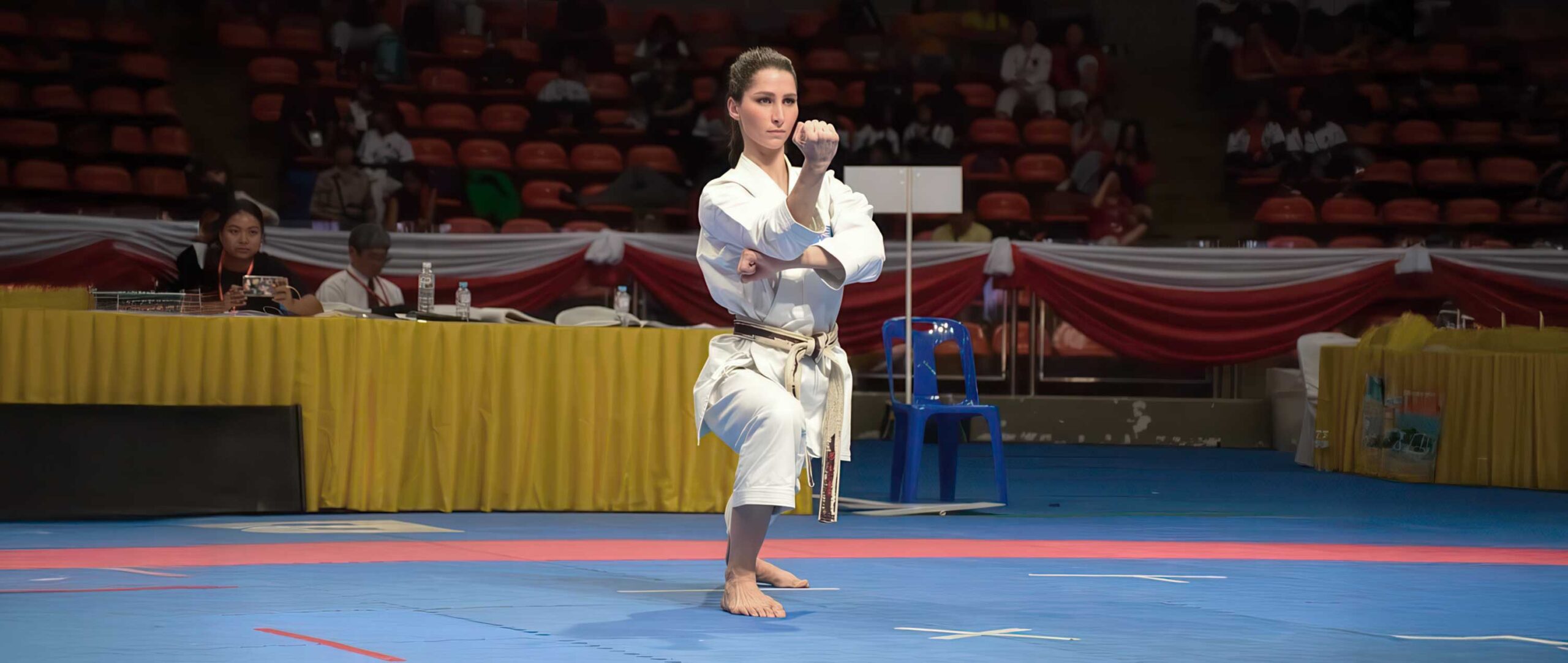
Gojūshiho Shō has always held a special place in my heart. I first performed it when I was 7 years old at the 1st WKF World Karate Championships in 1996 and it won me first place. From that moment, it became my go-to kata for competition.
Of course, as an adult I’ve come to appreciate its complexity and elegance in a whole new way. Even after 29 years of practicing the same kata, it continues to evolve with me; the way I move, my strength, timing, even how I understand things, it’s always changing. That’s what I love about karate. There’s always something new to sharpen or uncover. It never feels finished, and that’s what keeps it exciting.
TEACHING, LEADERSHIP, AND INFLUENCE
You’ve become an inspiration for many, especially women in karate. How do you see that role — and what message do you try to pass on to young women starting out?
That is very humbling. I’ve never specifically set out to be an inspiration, I feel that I’ve just followed my passion and worked hard at something I love. But if my journey encourages women around me to believe in themselves and stick with karate, then that means the world to me. Having strong role models shaped so much of who I am, so the idea that I could be that for someone else feels really special.
I would say to any young women starting out: you absolutely belong here, and you don’t need to be louder or tougher to earn respect – you just have to keep showing up! Work hard, trust yourself, and know that strength comes in many forms. And don’t be afraid to bring who you are to the dojo – karate needs all kinds of energy and spirit, and yours is valuable.
In your view, what makes a great karate instructor? And what advice would you give to someone just stepping into a teaching role?
I’ve had the privilege of training under many well-respected, high-level karate instructors. In my opinion, a great instructor has a genuine passion for helping others grow, and knows how to truly engage their students – not just through their technical skill, but through their presence, tone of voice, and ability to communicate with clarity and authority. I’m lucky to train with my dad, who embodies all of those qualities! He also brings his knowledge and history into the dojo in a way that adds depth to his explanations, making the training feel meaningful and not just mechanical.
My biggest piece of advice would be to see each student as an individual and learn how to guide them at their own pace, while still holding a strong standard. I don’t think teaching is about having all the answers… I think it’s about creating an environment where people feel safe to learn, make mistakes, and keep coming back!

REFLECTIONS AND VISION
You come from a strong karate family, but you’ve carved out your own path with integrity. What kind of legacy do you hope to leave behind — apart from the one you were born into?
I’m incredibly proud of the legacy I come from – it’s shaped so much of who I am and how I approach my karate training and teaching. But one of the biggest challenges has been figuring out how to contribute something of my own within that. I’ve never wanted to just follow the path – I’ve always felt a responsibility to add to it meaningfully and walk it in a way that’s true to me. For me at the moment, that means training with purpose and creating an environment where people feel supported and inspired to grow. If someone walks away from a class with me feeling empowered and inspired to keep going, then I’ve done my part to carry the legacy forward in my own way.
What are your current goals — whether technical, competitive, or personal – for this next chapter in your journey?
After 32 years, I feel everything is finally aligning – my experience, physical ability, and a deeper understanding of karate. I’m in a phase that feels like a personal peak. I can attribute that to focusing deliberately on the finer details: breaking down movements, refining timing and efficiency, and always looking for ways to raise my own standard. I’ve learned that without staying mentally engaged, there’s always a chance training can become dull and mechanical. As a kid, my dad use to say “put your thinking cap on” or “switch on your brain” and that has stuck with me, because karate is all about mental focus in order to have physical control. Being aware of how every part of my body moves and learning to master it is the challenge I most enjoy. So right now, I’m not chasing big titles or external goals; it’s more about training with depth and passing on what I’ve learned. I genuinely love helping others improve and sharing those insights. That’s where my passion lies now.
If you could pass on one message to the next generation of karateka in your family, or even your future self, what would it be?
Stay humble and find ways to keep your curiosity alive! It’s not about winning – it’s about who you become through it. Karate will always give back what you put in, but remember, everyone’s journey is different. Don’t waste time and energy comparing yourself to others, rather focus on protecting your love for the art.
QUICKFIRE ROUND
Favourite kata right now?
Unsu
Hardest lesson you’ve learned through karate?
I’m still learning not to let people’s opinions (like judges at competitions) affect how I feel about my own skills.
Best advice your father or grandfather ever gave you?
My grandfather led an incredible life and it wasn’t about what he said, but how he lived. He taught me two things: persevere, even when it’s hard, and stay humble enough to always keep learning. When he went to Japan to study karate, he was a total fish out of water, but he never gave up. He earned respect and brought that knowledge home, and even with everything he achieved, he’d still joke that he was a “no dan”. And for me, that said it all.
One thing you always say to your students?
Master the simple stuff and everything else will follow.
Three words that sum up your karate spirit?
Precision. Discipline. Heart.